
Protein is everywhere right now. Protein yoghurt, protein bread, protein ice cream. It can feel like you either need a tub of powder or you’re doing it wrong.
Here’s the honest version: what the official numbers say, why your needs go up as you get older, and the one habit that makes the biggest difference for most people over 40.
The Official Numbers
Australia’s recommended daily intakes are 64 grams a day for men and 46 grams for women. Over 70, that rises to 81 grams for men and 57 grams for women, because older adults need more protein to hold on to muscle.
Those figures are the minimum to avoid deficiency in the general population. They’re not a target for someone who’s training and wants to keep or build muscle.
Why You Need More as You Age
From your 40s onwards, your body gets less efficient at turning the protein you eat into muscle. At the same time, you naturally start losing muscle unless you do something about it. That combination is why experts who study ageing recommend more protein than the basic guidelines.
A group of international researchers who looked at this for older adults suggested a daily intake of around 1.0 to 1.2 grams of protein per kilogram of body weight, alongside regular strength and cardio exercise. For a 70-kilogram person, that’s 70 to 84 grams a day, which is a fair bit more than the basic figure.
That research was on people 65 and over, but the muscle-loss process starts well before then, which is why I pay attention to protein with every client over 40.
This is general information, not medical advice. If you have kidney disease or another health condition, check with your GP or a dietitian before changing your protein intake.
The Habit That Matters Most: Protein at Every Meal
Here’s the part most people miss. It’s not just how much protein you eat in a day. It’s how you spread it out.
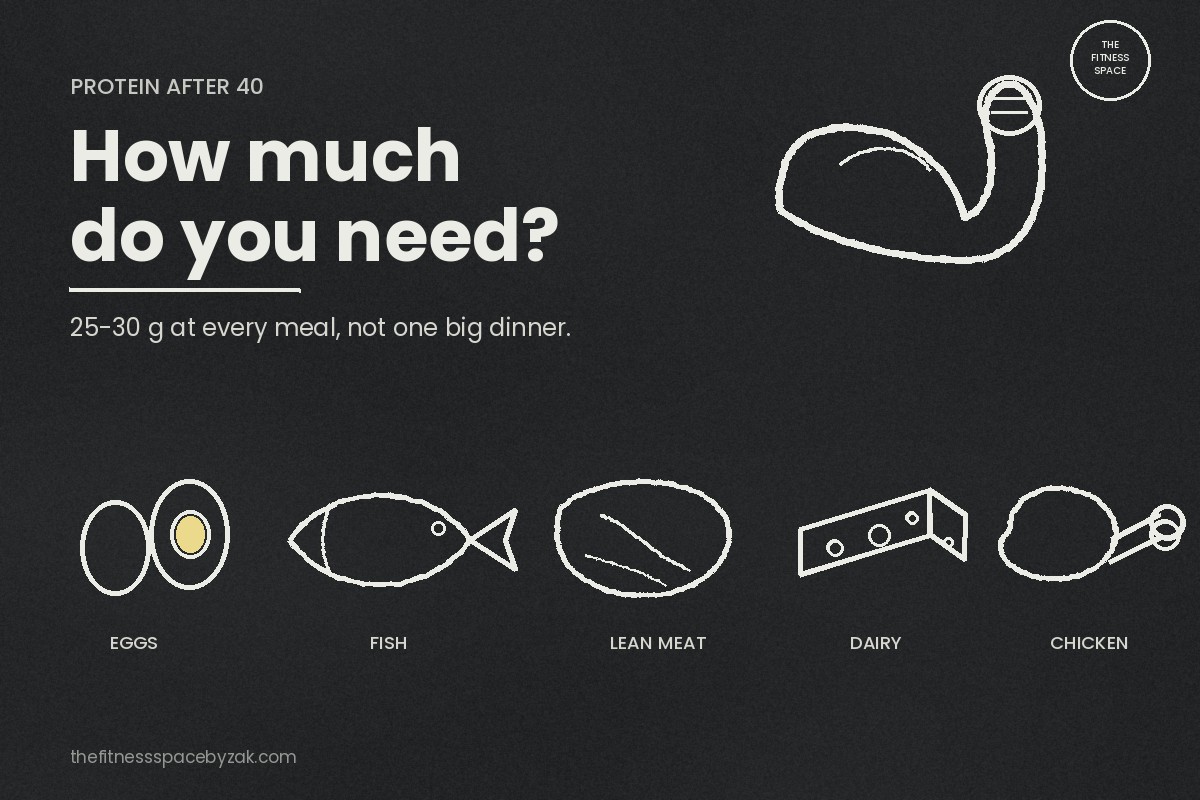
Research on older adults suggests aiming for roughly 25 to 30 grams of protein at each meal, rather than a tiny breakfast, a small lunch and a huge dinner. Your muscles can only use so much at once, so an even spread works better.
One study compared healthy older men (around 71) with younger men (around 22) to see how much protein in a single meal it took to fully switch on muscle building. The older men responded less to small servings and needed more per meal to get the same effect. That’s why a decent serve at every meal matters more as you get older. It’s a small study of men only, and it measured muscle building in the hours after a meal, not muscle size or strength over time, so I wouldn’t treat it as an exact number.
Breakfast is where most people fall down. Toast and a coffee is close to zero protein. Eggs, Greek yoghurt, milk or leftover dinner get you a long way towards that 25 to 30 grams before the day has started.
What I See With Clients
Across the board, my clients are under-eating protein. When they start tracking, or I point them in the right direction, they’re blown away by how little they’ve actually been getting.
I always say the same thing: you’re putting in the hard work in the gym, so why not put in the hard work in the kitchen too? Know your KPIs for your macros, especially your protein, so you can build the muscle you’re after. Otherwise all that extra effort is for nothing.
I used to write meal plans by hand, and I still do. But these days, with AI, I can sit down with a client for a few minutes and build a full meal plan around the foods they already eat. I tweak it here and there, so they’re eating normal food, just with more of what needs to go up.
One client in particular tracked her macros for 12 weeks. She nailed her calories, carbs, fats and especially her protein, and the difference in her body shape is amazing. She’s lost body fat and gained muscle.
Keep It Simple
You don’t need a kitchen full of protein products. Eggs, chicken, fish, lean meat, dairy, tofu, lentils and beans all count. Get a decent serve at each meal, train with weights a couple of times a week, and the rest takes care of itself.
If you’re wondering about supplements, my post on whether creatine is safe covers the one I actually recommend. And if you’d like someone to look at what you’re eating and build a plan around it, connect with me today.
Related reading: men’s strength training after 40 and protein powder: is it worth it.