
“Track your macros” gets thrown around like everyone knows what it means and everyone should do it. Neither is true.
Here’s what tracking actually involves, what the research says about whether it works, how I run it with clients, and who should give it a miss.
First, What Are Macros?
Macros are the three nutrients that give you energy: protein, carbohydrates and fat. Australia’s nutrition guidelines suggest a healthy spread of roughly 15 to 25 per cent of your energy from protein, 45 to 65 per cent from carbs, and 20 to 35 per cent from fat. Tracking macros just means logging what you eat so you can see where you actually sit against the numbers that suit your goal.
If you want the basics first, I cover what macros are in my post on common diet struggles. This post is about the doing.
Does Tracking Work? The Research
Yes, and the research is clear about the catch: it works when you do it consistently.
In a Duke University trial, 100 overweight adults used a tracking app for 12 weeks. The researchers counted someone as a “consistent tracker” if they logged six days out of seven, most weeks. Only a quarter of people managed it. But those who did lost about 2.4 kilos more than the inconsistent trackers by three months, and more than three times as many of them lost at least 5 per cent of their body weight.
A much larger analysis of more than 5,000 app users, published this year, found the same pattern. People logging six or seven days a week lost about 11 per cent of their body weight over six months, compared with under 7 per cent for people who logged less than two days. Every extra day of logging per week was linked to better odds of a meaningful result. That study was observational and the users were a motivated bunch, so take the exact numbers lightly. But the direction is the same in every study I’ve seen: the people who log, lose.
Here’s the encouraging bit from that same analysis: people who logged just two or three days a week still lost about 7 per cent. You don’t need a perfect record. You need a habit.
How I Set Clients Up
First, we sit down. I find out your age, height, weight, and how active you currently are. All of that goes into my calculation spreadsheet, and out comes a calorie figure for your goal, whether that’s losing fat, building muscle or holding where you are. Then we break it down: how much protein, how many carbs, how much fat. I also typically give clients 30 grams of fibre a day, just to keep you regular and healthy.
Then you download an app. Something like MyFitnessPal does the job, and it’s free or close to it. It tracks your macros and your calories, and I think it’s an awesome tool. It keeps you accountable, and it gives you real insight into what you’re actually eating, which is usually a surprise.
From there, you put your numbers into a shared Google Sheet that I can see on my computer and you can see on yours. You track everything. Every molecule that goes in your mouth.
What I Actually Look At
Not your Tuesday. Your week.
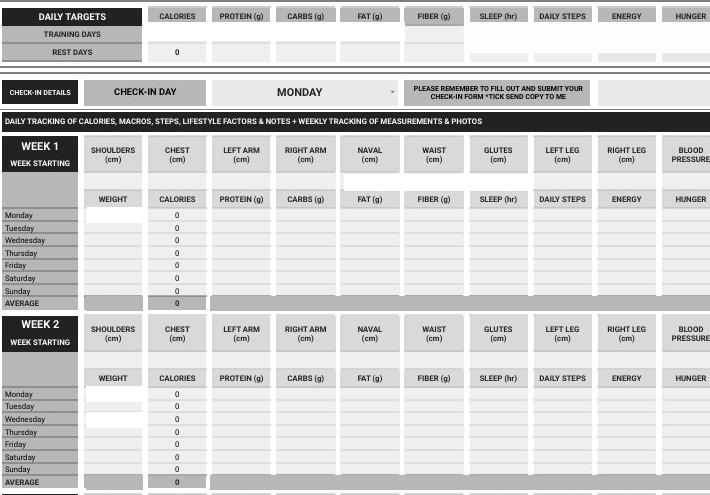
I’m not interested in day-to-day swings. From experience, clients can have wild fluctuations in calories and macros on any given day: a birthday party, a work dinner, a day in bed with a cold. Judging you on a single day tells us nothing. So we work with weekly averages: your weekly weigh-in, and your average protein, carbs and fat across the whole week. That gives a far more accurate picture of what’s actually happening, and it’s what gets results.
Who Shouldn’t Track
I’m really particular about who I put on tracking. If you have an eating disorder, or you’ve ever had an unhealthy relationship with food, counting what you eat is the wrong tool for you, and you’re not someone I’d ask to do it. That’s not a judgement. It’s me knowing where my job ends. Talk to your GP or a dietitian instead.
The Short Version
Tracking works because it shows you the truth about what you eat. Do it honestly, look at your weeks rather than your days, fix what’s off, and you’ll learn more than any diet plan will teach you. You’re putting in the hard work in the gym. This is the hard work in the kitchen, and it’s less work than you think.
If protein is the thing you’re short on, my post on how much protein you need after 40 is the next read. And if you’d like someone to set your numbers and check your log, connect with me today.
Related reading: sustainable weight loss and calorie intake and intermittent fasting after 40 and working with a qualified nutritionist in Maroubra.