
Heavy Lifting Tips for Women in Maroubra
Over the years training women in Maroubra, I’ve watched heavy lifting change more than just how strong someone is — it changes how they move, how they carry themselves, and how they feel in their own body. But “heavy lifting” can sound intimidating if you’ve never done it, so here’s what it actually looks like to get started, do it properly, and keep progressing.
Hormonal Response
Heavy lifting stimulates hormonal responses — testosterone and growth hormone — that are essential for muscle growth and repair. It’s part of why strength training does more for your body composition than cardio alone ever will.
Increased Bone Density
Heavy resistance training builds stronger bones, which matters more the older you get. I’ve written a full guide on this specifically — weight training and bone health — if you want the detail on why this matters so much, especially past 40.
Functional Strength
Lifting heavier weights translates directly into how you move through daily life — carrying shopping, picking up kids, getting up off the floor without thinking about it. That’s functional strength, and it only comes from actually challenging your muscles.
Caloric Burn
Heavy lifting builds muscle, and more muscle means a higher resting metabolism — you’re burning more just existing, not only during the session.
How I Actually Get Someone Started
I don’t put a new client on a fixed starting weight off a chart. I gauge it from the conversation we have before we start — what experience they’ve actually got — and then from how they move in the studio: their form, their facial expressions, their body language on the first few reps. That tells me more than any number would. We start conservative and calibrate from there.
What “Heavy” Actually Means
My clients don’t walk in asking to “lift heavy” — that’s not really how it works. Heavy is relative to the person lifting it. I’ve got a client who started last week who’s lifting 2 kilos, and right now, that’s heavy for her. I’ve got other clients lifting 30 kilos, and that’s heavy for them. Both are exactly where they should be — heavy isn’t a number on a chart, it’s whatever’s genuinely challenging for that person at that point.
That’s where the risk-versus-reward conversation comes in, which I’ve touched on in other posts. Lifting heavier than what you’re used to always carries some risk — that’s true at any weight. But when you’ve got a coach or trainer actually supervising you through it, that risk drops right down. That’s the real difference between pushing yourself safely and just guessing.
Getting Your Form Right
For squats, the cues I come back to every time: slow down, don’t rush. Grip the floor with your feet, feet slightly turned out. Lock your hips in. Shoulders back. Breathe normally — don’t hold your breath through the whole rep.
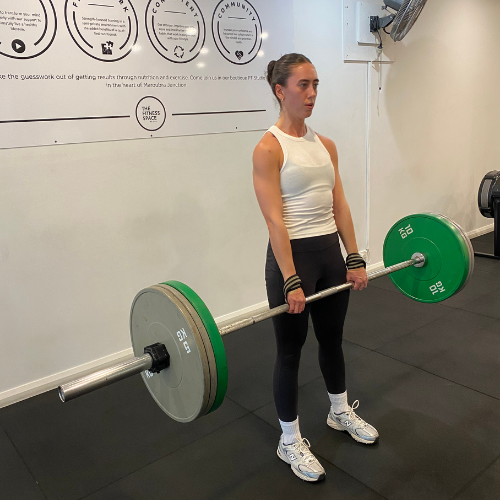
For deadlifts: slow down, tuck your chin in, shoulders back, lock your hips forward.
Get these right before you worry about the number on the bar. Form is what lets you actually keep lifting heavier without it catching up with you.
Progressing the Weight — Without Losing the Plot
Progressive overload matters, but consistency matters more. I say that to every client. Women’s training is genuinely unique week to week — your cycle, your emotional wellbeing, family life, kids — all of it affects what a session should look like. So increasing the weight isn’t always a week-to-week thing for everyone; sometimes it’s month-to-month. That’s completely fine. Showing up consistently outweighs chasing a heavier number every single week.
The “Bulking” Myth
Even after all these years of coaching, I still hear it: “I don’t want to look bulky.” And more often than not, I don’t think the client fully believes it herself — it’s less a real fear and more a knee-jerk reaction, something said before it’s even been thought through. I’m not always sure where it comes from, but if I had to guess, it’s rarely really about her at all. More often than not it traces back to someone else — a partner who feels a bit thrown by her getting stronger, without even realising that’s what’s actually going on.
Whatever the source, here’s the reality: heavy lifting doesn’t make women bulky. What you’ll actually see is toned, defined muscle — real definition, strong arms — as long as your diet’s dialled in alongside it. This fear stops more women from lifting heavy than almost anything else, and it shouldn’t.
Injury Prevention: What Actually Helps
Good form is the foundation, but there are specific exercises I build in around heavy lifting for injury prevention: hip bridges, external rotation work, half pigeon, bird dog. None of these are a guarantee against injury — nothing is — but they genuinely help keep everything on track as the weights go up.
When You Hit a Plateau
Plateaus happen to everyone. When I notice a client is starting to go quiet or drop off — I’ve usually got a hunch before they even say anything — I’ll text or call. Sometimes all it takes is a bit of a nudge in the right direction to get someone back on track.
What Changes Isn’t Just Strength
The biggest shift I see in clients who commit to heavy lifting isn’t just the numbers — it’s how they carry themselves. There’s a real confidence that comes with it: a bit more swagger, a bit more presence, a woman who feels genuinely comfortable and strong in her own body. Building lean muscle doesn’t take away from that — in my experience, it’s exactly what builds it.
Conclusion
Heavy lifting isn’t something to be scared of — it’s one of the most effective things you can do for your body, your bones, and your confidence, at any age. If you’re ready to actually get started with the right guidance, come check out a class and we’ll build it properly from wherever you’re starting.