
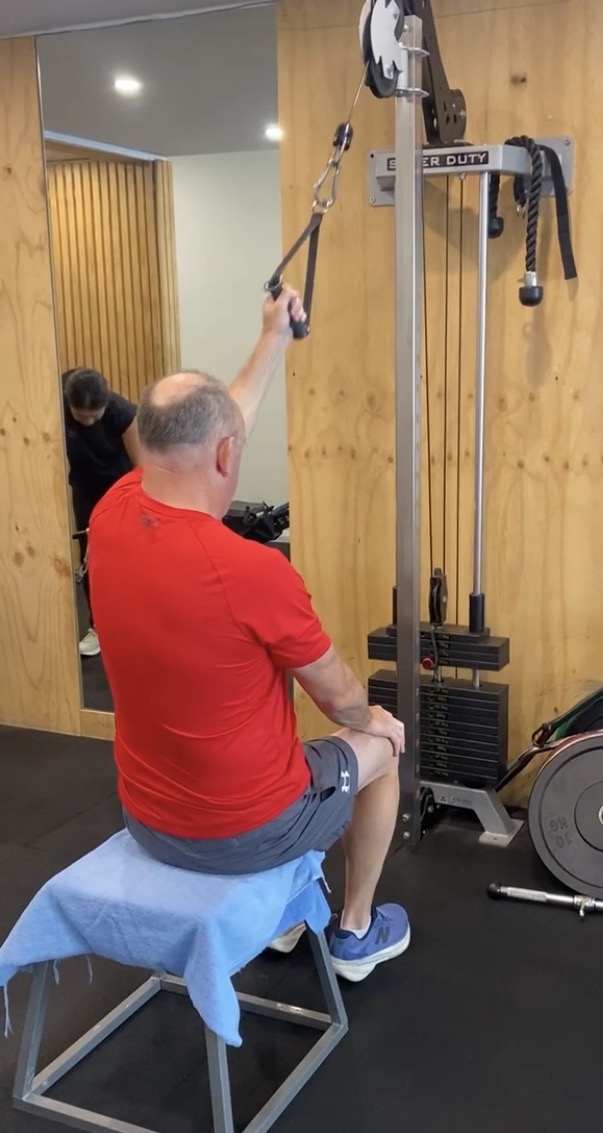
“I’ve got arthritis, so I can’t do weights.” I hear it a lot, and I understand why. When a joint hurts, resting it feels like the sensible thing to do.
But for most types of arthritis, the opposite is true. The right kind of exercise is one of the best treatments there is. I’m a trainer, not a doctor or a physio, so this isn’t medical advice. But here’s what Australia’s arthritis experts say, and how I work with sore joints in the studio.
What Arthritis Australia Says
Arthritis Australia’s advice is clear: being active is one of the most important things you can do. It recommends a mix of three things: flexibility work like stretching, muscle-strengthening work like weights or resistance bands, and fitness activity like brisk walking. The target is at least 30 minutes on most days, and it can be broken into short bouts.
Low-impact options are usually the most comfortable: walking, water exercise, cycling, tai chi, dancing. And strength training isn’t just allowed, it’s encouraged. For rheumatoid arthritis specifically, Arthritis Australia says muscle weakness can be prevented and even reversed by strength training.
Stronger muscles take load off the joint. That’s the whole idea.
The Two-Hour Pain Rule
This is the single most useful thing I can pass on. Arthritis Australia calls it the two-hour pain rule: if you have extra or unusual pain for more than two hours after exercising, you did too much. Pull back next time.
The other half of the rule matters just as much. Having your normal arthritis pain is not a reason to skip exercise. Many people with arthritis have some pain all the time. You stop if the pain is unusual, or if exercise pushes it beyond what’s normal for you. Otherwise, you keep going.
What a Proper Program Can Do
There’s an Australian program called GLA:D, run by trained physiotherapists, that combines education with a structured exercise program for knee and hip osteoarthritis. Researchers at La Trobe University tracked nearly 2,000 Australians who went through it. A year later, three quarters reported a meaningful improvement in pain and quality of life. And of the people who wanted knee surgery at the start but didn’t have it, three quarters no longer wanted it.
That’s exercise, not surgery, not injections. It’s the strongest evidence I know of that moving well, consistently, changes what arthritis does to you.
When to Stop and See Someone
Don’t vigorously exercise a joint that is red, hot, swollen or painful. That’s a flare, and the advice is to rest that joint, keep it moving gently, and train the rest of your body lightly if you feel well enough.
See your GP or physio if you haven’t had a proper diagnosis, if pain after exercise keeps lasting more than a couple of hours, or if a joint is getting worse. Arthritis Australia also suggests getting a doctor’s clearance before you start a new program, and a physio or exercise physiologist to help set it up. I work alongside both all the time, and I’d rather you had the right team than guess.
How I Train Around a Sore Joint
Over the years I’ve seen clients with arthritis in just about every joint there is, from the elbow to the big toe. The approach is always the same: work around it, don’t stop.
Having done this for so long, I can usually find a way around a specific movement. Say you’ve got arthritis in your big toe and it’s been fused. We’ll do a similar exercise, but break it down into its simplest form so you feel no pain. That might mean a dumbbell instead of a cable, or a stick as a prop to control your stability so the joint isn’t aggravated. You still train. You just train differently.
A Client Who Waited Too Long
One of my current clients had a hip replacement in the last 12 weeks, after years of chronic pain in that hip. About ten weeks after the operation, he was back training with me.
That didn’t happen by luck. Before the surgery we spent months and months training to get him as strong as we could, so that once his physio gave the OK, he could bounce straight back. That’s what pre-op training is for, and it paid off.
Here’s the part I want you to take from his story. I’d told him more than once in the past: go and see your physio, get this properly diagnosed. He put it off. Then one day, stepping down off a fairly low step, his hip locked and he couldn’t move. That’s when the penny dropped. Physio, then GP, then surgeon, then a new hip. His only regret now is not going earlier.
Sort it out at the start. Don’t wait for the step.
Keep the Joint Moving, Build the Muscle Around It
Arthritis changes how you train. It doesn’t stop you training. Keep the joint moving, build the muscle around it, respect the two-hour rule, and get the right people involved.
If it’s your knees that complain, my post on squats with sore knees goes into the specifics. If it’s your back, training with a sore lower back covers that. And if you’d like a program built around your joints, working alongside your physio or GP, connect with me today.
Related reading: lifting heavy with osteopenia or osteoporosis.