

Over the years training women through every stage of life, one thing has become obvious: what your body needs from training changes decade to decade — but the mistake I see most is women adjusting too early, backing off exactly when they should be doing the opposite. This is a real guide to what actually matters in your 20s, 30s, 40s and 50s, based on what I’ve actually seen work with the women I train here in Maroubra.
In Your 20s: Peak Fitness Exploration
Your 20s are a time of real fitness potential — your recovery is fast, your body can handle a lot of variety, and this is the time to experiment and find what you actually enjoy. Mix things up, push intensity, and build the habit of training consistently. Rest days still matter here — recovery is what lets the hard sessions actually count — but this is the decade with the most room to explore.
In Your 30s: Balancing Life’s Demands
Life gets busier in your 30s — careers ramp up, and for a lot of women this is when family life starts taking over the calendar. The goal here isn’t a perfect program, it’s a sustainable one. I’d rather see a client training consistently 3 times a week for years than smashing 6 sessions for a month and burning out. This is the decade to build a routine that survives a busy week, not one that only works when life is calm.
In Your 40s: Building the Base for Everything After
This is the decade that actually decides how the next 30 years go, and it’s the one most guides like this skip over. From your 40s onward you start losing muscle mass and bone density if you’re not actively working against it — and the women who get ahead of that now are the ones who are still strong, capable and injury-free well into their 60s and 70s. The ones who wait until their 50s or 60s to start are working against a much bigger deficit.
The single biggest thing I see separate clients who get real, lasting results from the ones who don’t isn’t the program — it’s consistency. The clients who turn up no matter what — who’ve got that “turn up and train” mindset even on the days they don’t feel like it — are the ones who look genuinely different after training with me for years, not weeks. And it tends to be the same people in the rest of their life too: the ones who turn up for work every day, who just put one foot in front of the other. That consistency is what actually compounds.
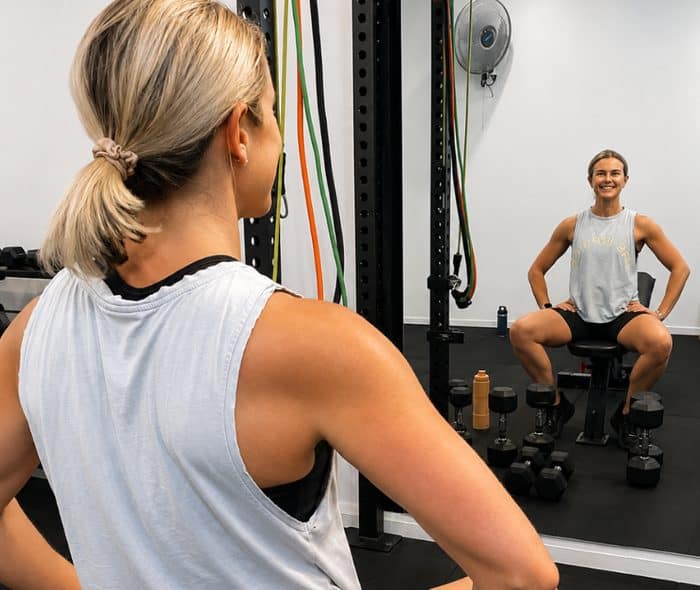
Angela is a great example of this. She’s a client I’ve trained who came in wanting to be more accountable to herself, and what I’ve watched happen over time is exactly that: she’s gotten stronger, fitter, and genuinely more confident — not because of one big change, but because she kept showing up. That’s the real story of what your 40s should be about: not chasing a quick result, but building the base of strength and consistency that carries you into everything after.
If you’re in your 40s and you’re not strength training yet, this is the decade to start — not the one to wait out.
Strength Doesn’t Stop at 50
Your 50s bring real changes — menopause affects bone density and muscle mass directly, and it’s exactly the wrong time to pull back to purely low-impact training. I’ve written more on this in my guide to weight training and bone health — the short version is that resistance training is one of the most effective things you can do for bone density at this stage, not something to avoid.
I’ve trained a client for about five years who’s the clearest example of this I can give you. For years, her routine was the same: come in, get her gear on, headphones in, jump on the cross trainer, walk for 40 minutes, and leave — because she’d been told cardio was the way to lose weight, and that was genuinely her goal. Five years of that same routine, and she wasn’t getting anywhere. It’s an easy rut to fall into — it’s set and forget, it doesn’t ask much of you, and the idea of being properly challenged at that age can feel daunting. But when she actually started strength training, everything changed. She realised she could still challenge herself, still lift, still be active — and she started actually enjoying her training for the first time, instead of just getting through it.
That’s the pattern I see over and over in this decade: women who were told (or just assumed) that low-impact was the “safe” choice, when it’s often the opposite of what their body actually needs. If you want more on this specifically, I’ve also put together a guide to heavy lifting for women that goes into more detail.
The Real Takeaway
None of this is about age being a limit — it’s about what each decade needs so the next one isn’t harder than it has to be. Build the habit in your 20s, protect it through your 30s, invest heavily in strength in your 40s, and don’t back off it in your 50s. If you want help figuring out where you’re actually at and what your training should focus on, come check out a class — that’s exactly the kind of thing I work through with every new client.